
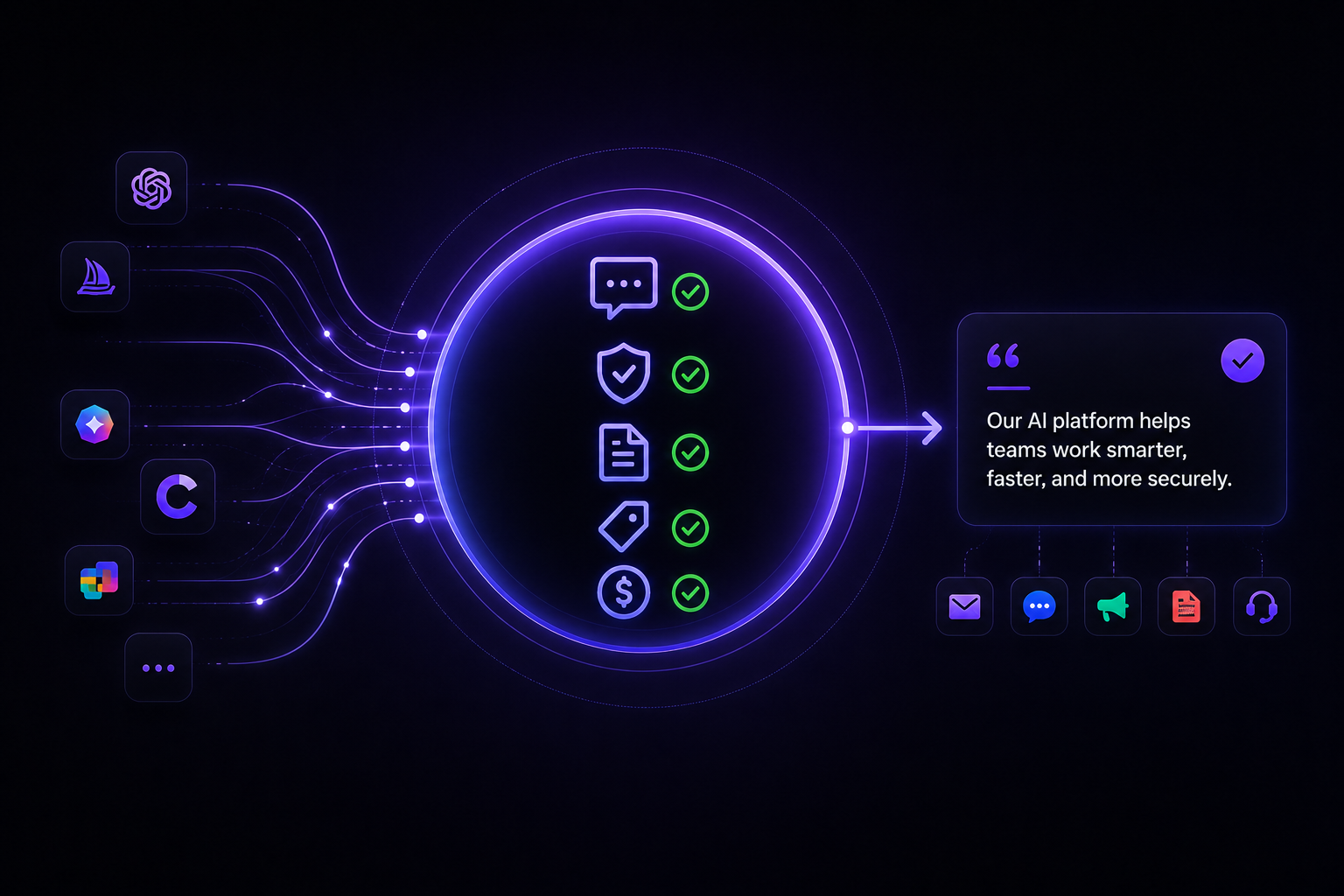
Most enterprise AI governance efforts are focused on the wrong problem.
As AI generates more customer-facing content, the biggest governance challenge won't be controlling what goes into the model. It will be controlling what comes out.
- Enterprise AI governance has a blind spot Most governance programs focus on security, privacy, and access controls. Very few address how AI communicates with customers, prospects, investors, and partners.
- AI creates communication risk at scale A chatbot using the wrong product description, a sales email making an unsupported claim, or an AI-generated investor update missing required disclosures can create problems even when all security controls are working perfectly.
- Messaging drift happens gradually AI rarely produces catastrophic messaging failures. More often, it slowly introduces inconsistencies in positioning, terminology, pricing language, competitive messaging, and product claims. Over time, every team starts telling a slightly different story.
Over the last two years, organizations have invested enormous amounts of time thinking about how employees use AI. Security teams have built controls around sensitive data. Legal teams have developed usage policies. IT teams have approved vendors, restricted access, and created governance frameworks.
Yet very few organizations have addressed a much more practical question:
How do we control what AI says on behalf of the company?
That question is becoming increasingly important because AI is no longer just helping employees brainstorm. It is helping write sales emails, customer support responses, marketing campaigns, product descriptions, chatbot conversations, investor communications, proposals, and partner communications.
In many organizations, AI is already participating in customer-facing communications at a scale that no human review process can realistically keep up with.
And that is where the messaging governance gap begins.
What is messaging governance?
Messaging governance is the practice of ensuring that customer-facing communications remain aligned with approved messaging, product claims, disclosures, terminology, and brand standards.
This is not a new discipline. Long before AI, companies invested heavily in controlling how they communicated with the market. Product marketing teams developed positioning and messaging frameworks. Brand teams established voice and tone guidelines. Legal teams approved claims and disclosures. Revenue enablement teams trained sellers on approved talk tracks.
The assumption behind all of these activities was simple: humans create content, so humans can be trained to follow the rules.
##Generative AI changes that assumption.
Today, AI is involved in writing a growing percentage of customer-facing communications. Unlike a trained employee, an LLM does not know which claims are approved, which terminology is preferred, which competitive comparisons are allowed, or which disclosures must accompany a specific statement. It generates the most likely response based on the information and instructions available to it.
That means messaging can no longer rely entirely on documentation, training, and review processes. Organizations need a way to operationalize messaging standards so they can be applied consistently at scale.
Why does enterprise AI governance have a messaging problem?
Most enterprise AI governance programs were built around security, privacy, and compliance concerns.
The early questions were completely reasonable:
- Can employees use ChatGPT?
- Which AI tools are approved?
- Can customer data be uploaded?
- Can source code be shared?
- How are prompts stored?
- How are interactions logged?
These concerns shaped the first generation of AI governance frameworks. As a result, organizations became very good at controlling who could use AI and what information could be shared with it.
What they did not build were controls around what AI communicates.
That distinction matters because customers never experience your governance framework. They experience your communications.
A prospect receiving an AI-generated sales email does not know whether your company has excellent prompt retention policies. They care whether the email accurately represents the product.
A customer interacting with a chatbot does not care how carefully your access controls are configured. They care whether the response is accurate, helpful, and aligned with reality.
The first wave of AI governance focused on inputs.
The next wave will need to focus on outputs.
Why isn't hallucination the biggest problem?
When people discuss AI communication risks, hallucinations tend to dominate the conversation.
Hallucinations are certainly a concern. Nobody wants an AI system inventing product capabilities, customer references, or regulatory requirements.
But for most enterprises, the bigger challenge is not hallucination.
It's drift.
Messaging drift happens when AI gradually moves away from approved messaging, terminology, positioning, and claims.
Imagine a product marketing team spends six months refining the positioning for a new offering. After dozens of customer interviews and competitive analyses, they arrive at a clear narrative.
Then AI starts helping hundreds of employees create content.
The approved positioning describes the product as an "AI agent platform."
Within a few months, AI-generated content refers to it as a chatbot, virtual assistant, automation engine, conversational AI platform, digital worker, intelligent assistant, and workflow orchestrator.
None of these descriptions are necessarily wrong.
The problem is that every team starts telling a slightly different story.
The same thing happens with competitive messaging, pricing language, customer commitments, and product claims. Over time, the organization loses consistency not because anyone intentionally ignored the guidelines, but because AI generated thousands of reasonable alternatives.
This is one of the most overlooked consequences of enterprise AI adoption. The challenge is not always that AI says something wildly incorrect. Sometimes it simply says something slightly different thousands of times.
Why can't organizations simply review AI-generated content?
Historically, review was the primary mechanism for controlling messaging quality.
Marketing reviewed campaigns. Legal reviewed disclosures. Brand teams reviewed external communications. Investor relations reviewed earnings materials. Product marketing reviewed launch content.
The process was not perfect, but it worked because content volume was relatively manageable.
AI changes the economics.
Today, a single sales representative can generate hundreds of personalized emails. Customer support teams can draft responses in seconds. Marketing teams can create campaign variations almost instantly. Chatbots can engage with thousands of customers simultaneously.
Communication volume is increasing dramatically.
The size of legal, brand, compliance, and product marketing teams is not.
Eventually every organization reaches the same conclusion: there is simply too much AI-generated content to review manually.
The question then becomes how to maintain quality and consistency when human review is no longer feasible for every interaction.
Why doesn't prompt engineering scale?
Whenever messaging governance comes up, someone eventually suggests putting all the rules in the prompt.
At first glance, this seems logical. If you want AI to use approved messaging, avoid certain claims, and include required disclosures, why not simply tell it to do so?
The problem is that prompts were designed to guide content generation. They were never designed to become an enterprise governance system.
Consider what happens when a company updates its positioning. Product marketing decides to stop calling something a "chatbot" and start calling it an "AI agent." A new disclosure requirement is introduced. Legal updates approved competitive messaging.
Where do those changes need to be made?
Potentially everywhere.
ChatGPT prompts. Claude prompts. Copilot instructions. Internal AI agents. CRM workflows. Support automation systems. Marketing tools. New applications that appeared three months ago and were never formally documented.
Meanwhile, the teams responsible for messaging already have plenty to do.
Product marketers are launching products and supporting sales teams. Brand teams are managing campaigns. Legal teams are reviewing contracts and regulatory requirements. Revenue enablement teams are training sellers. None of them signed up to spend their days maintaining prompt libraries across dozens of AI systems.
Prompt-based governance eventually creates a maintenance problem.
Different teams create different prompts. Employees modify instructions. Vendors update workflows. New AI tools enter the organization. Before long, there are dozens of slightly different versions of the company's messaging standards scattered across the business.
The result is predictable. One team uses outdated positioning. Another uses old pricing language. A third uses competitive claims that were never approved.
Everyone thinks they are following the rules because everyone has a prompt.
This is why governance cannot live inside prompts alone.
Prompts are useful.
Governance requires a centralized source of truth that can be updated once and applied consistently everywhere.
What does effective messaging governance look like?
The organizations that succeed with AI will not necessarily have the largest models or the most sophisticated prompts.
They will have a clear system for controlling customer-facing communications.
That starts with a centralized source of truth for:
- Approved messaging
- Product claims
- Competitive positioning
- Legal disclosures
- Brand standards
- Terminology
- Customer commitments
From there, those standards need to be consistently applied across every AI tool employees use.
The goal is not to slow down content creation.
The goal is to ensure that AI scales approved communications rather than creating new versions of them.
In practical terms, that means organizations need ways to verify claims, enforce terminology, apply required disclosures, identify messaging drift, and maintain consistency across channels and teams.
Why is messaging governance becoming a core part of enterprise AI governance?
The first phase of enterprise AI governance was about access.
Who can use AI?
The second phase focused on data.
What information can be shared with AI?
The next phase will focus on communication.
What can AI say?
As AI becomes embedded in sales, marketing, customer support, investor relations, and customer success workflows, organizations will need mechanisms for governing communications at the same scale they govern data.
That requires a different mindset.
Messaging can no longer be treated as a collection of documents sitting in a shared drive. It needs to become operational infrastructure.
The companies that recognize this early will have a significant advantage. They will move faster, maintain consistency across channels, and reduce the risk that comes from thousands of AI-generated customer interactions.
Most importantly, they will maintain control over their story.
Because customers may never see your AI governance framework.
But they will absolutely notice what your AI says.
Common questions
What is messaging governance?
Messaging governance is the practice of ensuring that customer-facing communications consistently align with approved messaging, product claims, disclosures, brand standards, and company policies.
Traditionally, messaging governance was managed through review processes, style guides, approval workflows, and training. As AI becomes responsible for generating more customer-facing content, organizations need ways to apply those standards automatically and at scale.
How is messaging governance different from AI governance?
AI governance focuses on how AI is used within an organization. This includes model access, data privacy, security controls, compliance requirements, and risk management.
Messaging governance focuses on what AI communicates. It addresses questions such as:
Are product claims accurate? Is the messaging aligned with approved positioning? Are required disclosures included? Does the content reflect the company's brand voice? Is pricing information current?
Organizations increasingly need both disciplines.
Why is messaging governance becoming important now?
Generative AI has dramatically increased the volume of customer-facing content being produced across sales, marketing, support, investor relations, and customer success.
While organizations have invested heavily in governing AI access and data usage, many have not established processes for governing AI-generated communications. As AI becomes a larger part of customer interactions, maintaining messaging consistency becomes more difficult and more important.
What is messaging drift?
Messaging drift occurs when AI-generated content gradually moves away from approved company messaging.
This often appears as inconsistent terminology, outdated positioning, unsupported product claims, inaccurate pricing language, inconsistent competitive messaging, or variations in brand voice across different channels and teams.
Unlike a single compliance violation, messaging drift usually develops slowly and becomes noticeable only after hundreds or thousands of customer interactions.
Put your messaging rules in one policy layer.
Get on the early-access list and we'll show you what enforced AI governance looks like on your own content.