
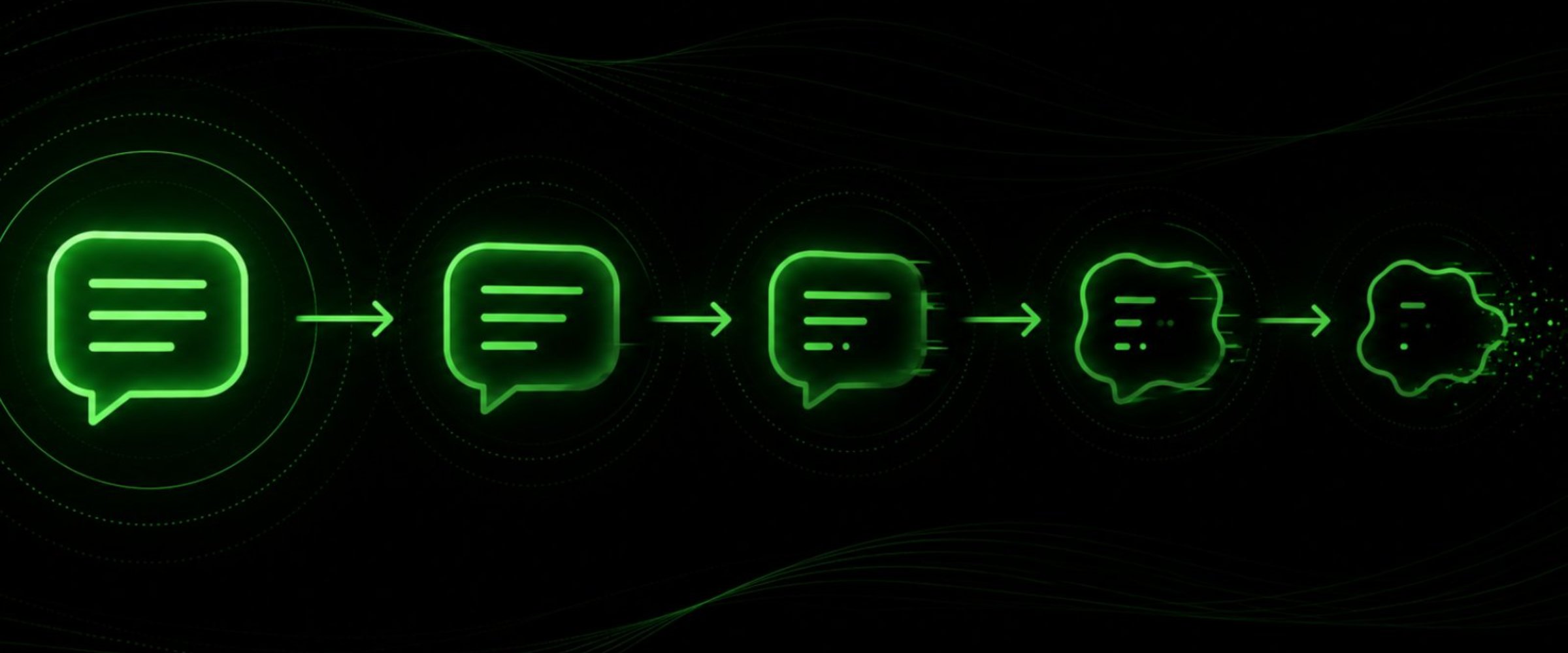
Messaging drift occurs when customer-facing communications gradually diverge from a company's approved messaging, positioning, terminology, claims, and communication standards. While the problem has existed for decades, generative AI has dramatically increased both the speed and scale at which messaging drift can occur.
Organizations adopting AI face a new challenge: maintaining a single, consistent message across thousands of AI-generated communications, dozens of teams, and an increasingly fragmented technology stack.
This guide explains what messaging drift is, why it happens, how AI accelerates it, and what organizations can do to prevent it.
- Messaging drift is the gradual divergence between a company's intended message and the message customers actually receive.
- AI accelerates messaging drift by dramatically increasing the volume and speed of customer-facing content creation.
- The biggest risk isn't bad content. It's plausible content that subtly changes positioning, claims, terminology, or disclosures.
What Is Messaging Drift?
Messaging drift is the gradual divergence between a company's intended message and the message customers actually receive.
Every organization has a set of communication standards. These standards may include positioning, value propositions, approved terminology, product claims, legal disclaimers, competitive positioning, brand voice guidelines, and regulatory requirements. Together, these elements define how a company presents itself to the market.
In theory, every customer-facing communication should reinforce those standards. In practice, however, messages change as they move through organizations.
Sales teams adapt pitches. Marketing teams create campaigns. Agencies rewrite copy. Customer success managers explain products in their own words. Support teams simplify technical concepts. AI tools generate content based on incomplete context.
AI can generate infinite variations. Your customers should hear one message.
Over time, these small changes accumulate.
The result is messaging drift: a state where different teams, channels, and systems communicate different versions of the same story.
Messaging drift is rarely intentional. Most organizations do not wake up one day and decide to abandon their messaging strategy. Instead, messaging gradually evolves through thousands of individual decisions made across the business.
The challenge is that customers do not experience those decisions independently. They experience the aggregate result.
When messaging drift occurs, customers begin hearing different answers to the same questions depending on who they interact with, which channel they use, or which AI system generated the communication.
Why Does Messaging Drift Happen?
Messaging drift is a natural consequence of organizational growth.
The moment a company expands beyond a single founder, communication begins to fragment. Different teams optimize for different objectives. Marketing focuses on awareness. Sales focuses on conversion. Customer success focuses on adoption. Support focuses on problem resolution. Product teams focus on capabilities.
While these teams share the same organizational goals, they often develop different ways of describing the company's products, value proposition, and competitive advantages.
The problem becomes more pronounced as organizations add:
- New employees
- New regions
- New product lines
- New agencies
- New partners
- New communication channels
Every additional participant introduces another opportunity for interpretation.
Without a mechanism for governance, messaging slowly diverges from its original source.
Is Messaging Drift The Same As Brand Drift?
Not exactly.
Brand drift and messaging drift are related but distinct concepts.
Brand drift typically refers to changes in visual identity, tone of voice, style, and brand personality. It occurs when organizations become inconsistent in how they look and sound.
Messaging drift is broader.
It includes:
- Positioning
- Product claims
- Value propositions
- Terminology
- Legal disclaimers
- Regulatory disclosures
- Competitive positioning
- Pricing language
- Brand voice
Brand drift is often one symptom of messaging drift.
An organization may maintain a consistent visual identity while simultaneously allowing messaging to fragment across teams and channels.
For this reason, messaging drift should be viewed as an operational challenge rather than a purely branding challenge.
Why Is Messaging Drift Becoming A Bigger Problem?
For decades, messaging drift was constrained by human capacity.
Content creation was relatively expensive. Most customer-facing communications passed through some form of review process. Marketing teams controlled major messaging assets. Brand teams enforced guidelines. Legal teams reviewed important communications.
Generative AI changes these economics.
Today, anyone can generate customer-facing content in seconds.
A marketer can create dozens of campaign variations.
A sales representative can generate personalized outreach for hundreds of prospects.
A support team can automate responses.
Customer success teams can create communications at scale.
The result is a dramatic increase in communication volume.
Unfortunately, governance processes have not evolved at the same pace.
Organizations are producing more content than they can realistically review.
This creates the ideal conditions for messaging drift.
How Does AI Accelerate Messaging Drift?
AI does not create messaging drift. It accelerates it.
Generative AI systems do not possess an understanding of company messaging. They generate content based on prompts, context, training data, and probability.
Unless explicitly guided, AI does not know:
- Which product claims are approved
- Which disclosures are required
- Which terminology should be used
- Which competitors can be referenced
- Which statements create legal risk
- Which promises should never be made
As organizations deploy multiple AI systems, the problem compounds.
Marketing may use ChatGPT.
Sales may use Copilot.
Customer support may use an internal agent.
Agencies may use Claude.
Each system receives different instructions.
Each system develops different outputs.
Each system contributes to drift.
What begins as a single messaging framework eventually becomes dozens of independent interpretations.
What Are Examples Of Messaging Drift?
Consider the following examples.
Product Claims
Approved message:
"Customers have achieved up to 40% ROI improvements."
Drifted message:
"Guaranteed 40% ROI."
A benchmark becomes a promise.
Product Positioning
Approved message:
"AI-assisted workflow automation."
Drifted message:
"Fully autonomous AI."
A positioning statement becomes an unsupported claim.
Brand Terminology
Approved term:
"AI Agent"
Drifted terms:
- Chatbot
- Virtual assistant
- Digital employee
- Autonomous worker
Customers encounter different product descriptions across channels.
Competitive Positioning
Approved message:
"Designed for enterprise governance."
Drifted message:
"Competitors don't provide governance."
A positioning statement becomes a legal risk.
What Are The Business Risks Of Messaging Drift?
Messaging drift affects far more than brand consistency.
It creates operational, financial, legal, and strategic consequences.
Customer Confusion
Customers struggle to understand what the company actually does.
Lost Revenue
Prospects hear inconsistent value propositions.
Reduced Trust
Contradictory messaging weakens credibility.
Compliance Violations
Required disclosures may be omitted.
Legal Exposure
Unapproved claims may be distributed at scale.
Operational Inefficiency
Teams spend significant time correcting avoidable inconsistencies.
Can't Prompt Engineering Solve This Problem?
Many organizations attempt to manage messaging consistency through prompt engineering.
Initially, this appears effective.
Teams create prompts that include approved terminology, positioning, disclaimers, and style guidance.
The challenge is that prompts do not scale.
As AI adoption grows, organizations accumulate:
- Marketing prompts
- Sales prompts
- Support prompts
- Customer success prompts
- Copilot instructions
- Internal agent prompts
Each prompt becomes another version of the truth.
Every messaging update requires dozens of changes.
Every policy change requires dozens of changes.
Eventually, maintaining consistency becomes impossible.
Prompts are not governance.
Prompts can guide behavior. Governance creates accountability, consistency, visibility, and enforcement.
What Is Messaging Governance?
Messaging governance is the practice of defining, managing, distributing, monitoring, and enforcing communication policies across customer-facing communications.
These policies may include:
- Approved messaging
- Product claims
- Brand voice
- Legal disclaimers
- Regulatory disclosures
- Competitive positioning
- Privacy requirements
- Industry-specific communication rules
Messaging governance provides organizations with a centralized source of truth that can be applied consistently across teams, channels, and AI systems.
How Can Organizations Prevent Messaging Drift?
Preventing messaging drift requires more than documentation.
Organizations need systems that can scale alongside content creation.
Best practices include:
- Establish a centralized messaging source of truth.
- Standardize approved claims and terminology.
- Govern AI-generated content.
- Verify customer-facing communications before publication.
- Monitor deviations continuously.
- Audit communications across teams and channels.
- Update policies centrally rather than through individual prompts.
Why Messaging Governance Will Matter More In The Future
The future of communication will be increasingly AI-generated.
Marketing, sales, support, customer success, investor relations, and product teams will all rely on AI systems to create content at unprecedented scale.
The question is no longer whether organizations will adopt AI.
The question is whether they can maintain control over what AI says on their behalf.
The companies that succeed will not necessarily be the ones generating the most content.
They will be the ones capable of maintaining a single, consistent message across every customer interaction.
That is ultimately the challenge messaging governance is designed to solve.
Common questions
What is messaging drift?
Messaging drift is the gradual process by which customer-facing communications diverge from a company's approved messaging, positioning, terminology, claims, and communication standards. Over time, different teams, channels, agencies, and AI tools begin communicating slightly different versions of the same story.
What causes messaging drift?
Messaging drift is typically caused by growth and complexity. As organizations add new teams, products, agencies, channels, and AI tools, messaging becomes increasingly difficult to maintain consistently. Small changes accumulate over time until multiple versions of the company's message exist simultaneously.
Is messaging drift the same as brand drift?
No. Brand drift is usually limited to visual identity, tone of voice, and brand personality. Messaging drift is broader and includes positioning, value propositions, product claims, terminology, disclosures, pricing language, and competitive positioning.
How does AI contribute to messaging drift?
AI generates content based on the instructions and context it receives. If that context is incomplete, outdated, or inconsistent, AI can amplify messaging drift at scale. What was once an occasional inconsistency can become thousands of inconsistent customer-facing communications.
Why doesn't prompt engineering solve messaging drift?
Prompt engineering works at the tool level, not the organizational level. As companies adopt more AI tools, prompts multiply across teams and workflows. Maintaining hundreds of prompts eventually becomes a governance problem. Every prompt becomes another copy of your policies that must be updated and maintained.
What are examples of messaging drift?
Common examples include:
Unsupported product claims Inconsistent terminology Missing legal disclaimers Outdated pricing language Unapproved competitor comparisons Different value propositions across teams Contradictory product positioning
How do you prevent messaging drift?
Organizations can reduce messaging drift by:
Creating a centralized messaging source of truth Standardizing approved claims and terminology Governing AI-generated content Verifying customer-facing communications before publication Monitoring messaging across channels and teams Replacing scattered prompts with centralized communication policies
Put your messaging rules in one policy layer.
Get on the early-access list and we'll show you what enforced AI governance looks like on your own content.